
Case Studies

AIRBUS SA330-SM PUMA MK2 Centre Troop Seat Re-Design

Introduction

AFD Systems was engaged by AIRBUS Helicopters UK to support the re-design of the centre seats installed into SA330-SM PUMA MK2 military rotorcraft.

Download case study (pdf)

Task Objectives

The seats were originally designed and certified in 1965 by SUD Aviation, in accordance with FAR 29 airworthiness regulations.

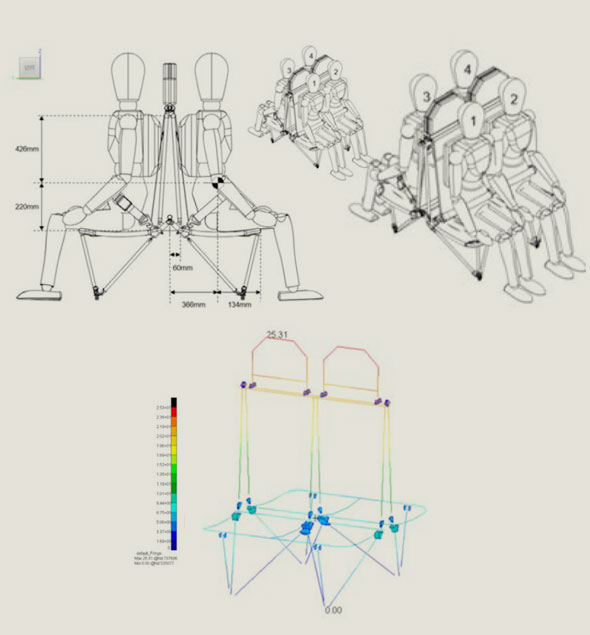
The seat assembly forms a quad seating arrangement that separates/folds into two halves for stowage when not in use.

The seat structure is fabricated from steel tubing, welded to steel plate end fittings.

The various tubular members are joined together via pinned joints. The entire quad assembly attaches to the cabin floor at four locations, fixed in X, Y and Z. The seat utilises lap restraints and includes a fabric seat pan and back.

An MOD safety inquiry resulted in the requirement for improvements to the seat to improve occupant safety. The primary improvements involved the introduction of a higher seat back and head restraints. The introduction of a 4-point occupant restraint was also investigated. The improvements were focussed around improving occupant safety during a crashlanding scenario and high lateral ‘g’ forces.

Analysis

The analysis required a complete understanding of the external loads
(crash conditions) and how to distribute the loads into the seat structure.

A finite element model (FEM) representing the original (baseline) quad seat was created and loaded in order to replicate the original hand analysis and to confirm the baseline strength prior to modification. The model was then adapted to investigate: the impact and benefit for increasing the seat back height; including the head restraint, and the introduction of a 4-point occupant restraint.

Outcomes

Outcomes Using the FEM, AFD were able to steer and optimise the design and sizing of the structure and ensure that the modified design possessed adequate static material and joint strength. AFD delivered a comprehensive Stress Report that presented the substantiation for a compliant design (with all Reserve Factors 1.0) and reported interface loads within the allowable load envelope for the floor hard points.

“It was great to hear that AFD were supporting the redesign of the seat owing to their track record in creating a seamless integration with the design team. AFD are proactive and add real value to the design process from start to finish, guiding the structural design towards a positive and optimised solution.”

Dan Williams | Design Engineer

Trusted by organisations across the world